

In Rungano Nyoni’s I Am Not a Witch (2017), the absurd and the tragic exist in a state of delicate equilibrium. Set in contemporary Zambia, the film introduces Shula (Margaret Mulubwa), an eight-year-old girl accused of witchcraft after an ordinary village mishap. Exiled without trial to a state-run witch camp, she joins older women tethered to large spools of white ribbon anchored by heavy wooden frames. Nyoni’s vision transforms a social-realist premise into a satiric fable, using its visual language and thematic composure to interrogate institutional exploitation, state power, and the silencing of vulnerable figures.
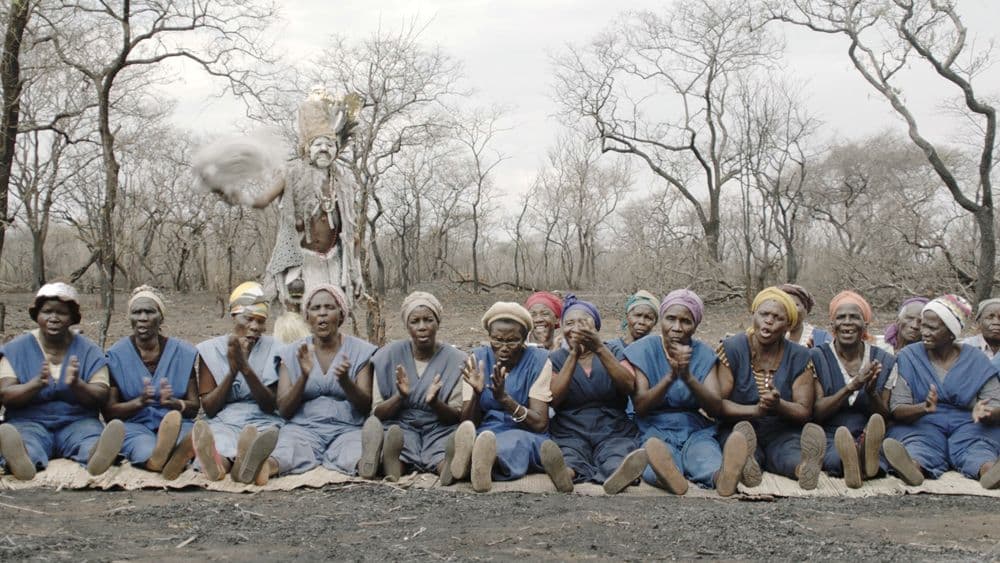
The film operates as a vivid study in necropolitics, a framework outlined by Achille Mbembe wherein sovereign power asserts itself through the capacity to dictate who matters and who is disposable. In Nyoni’s world, the Zambian state and local authorities exercise this ultimate control over the accused women, reducing them to what Giorgio Agamben terms homo sacer—individuals stripped of legal rights and civil existence, existing in a state of permanent exception.
The white ribbon physicalizes this necropolitical boundary. Spooling out hundreds of yards from truck beds, trees, and buildings, the fabric functions as a physical leash, an administrative constraint, and a visual marker of social death. The women face a strict ultimatum: accept their status as witches of the state while living tied to the ribbon, or sever the bond and accept transformation into a goat. This coercive threat frames absolute subjugation as the sole pathway to bodily survival.

The structural enclosure the women are tethered relies directly on the logic of Guy Debord’s Society of the Spectacle, where human relationships and authentic lived experiences undergo complete replacement by images and commodity representation. In Nyoni's narrative, spiritual terror and state power no longer govern through brute force alone as dominance can be maintained through mediated performance.
Mr. Banda (Henry B.J. Phiri), a government official, functions as a Mandarin of the integrated spectacle. Under his venal management, Shula's alleged spiritual powers undergo total conversion into media commodities. She appears on television broadcasts, and gets paraded before crowds as a public attraction. The tragedy of her captivity becomes secondary to her visual utility as a promotional asset.
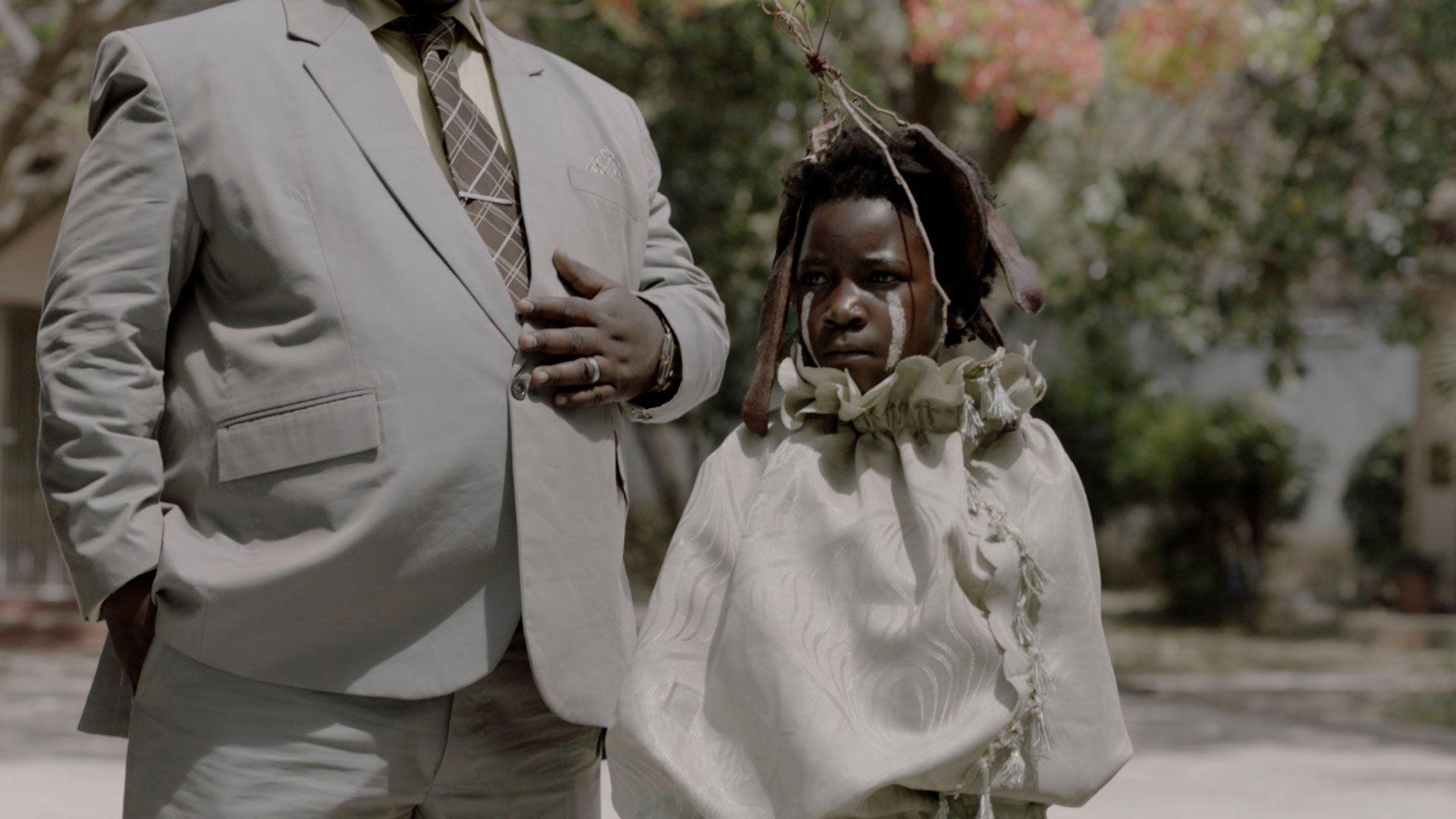
This Debordian commodification reaches its apogee with the arrival of tour buses at the witch camp. Foreign tourists pay for access, taking photographs of the bound women and purchasing decorative ribbons as souvenirs. Real human suffering and structural violence undergoing transformation into an exoticized cultural performance packaged for foreign consumption. The camp operates as a living museum where authentic social relations disappear behind the visual economy of tourism, turning marginalization into a profitable image.
The institutional scapegoating they are subjected to echoes the historical particulars of the Salem witch trials of 1692. Much like Salem, where societal paranoia, economic tensions, and religious orthodoxy converged to target women outside orthodox social bounds, the accusations in Nyoni’s film stem from trivial everyday misfortunes. Both Salem and Nyoni’s Zambia demonstrate how communities in crisis displace their systemic anxieties upon disenfranchised individuals. The accusations serve a clear structural utility, one that aids in preserving communal cohesion by the immolation of the agreed-upon deviant.
At the center of this exploitative circus, Shula's silence haunts the narrative. Played by non-professional actor Margaret Mulubwa, Shula observes the absurdities around her, providing a quiet counterpoint to the cacophony of the adults controlling her life. This silence underscores the complete denial of Shula's agency, as her opinion and emotional state remain entirely ignored while external projections define her. In a world governed by opportunistic rhetoric and spectacular display, Shula’s silence preserves her juvenile dignity even as her physical autonomy remains stripped away.

The older women in the camp offer a preview of Shula’s potential future. Having accepted their fate, they navigate imprisonment with union-esque camaraderie and weary resignation. They care for Shula while simultaneously enforcing the rules of their captivity, demonstrating how systemic oppression compels marginalized individuals to participate in their own containment.
Nyoni’s directorial choices elevate the narrative beyond straightforward satire. Classical Western compositions—such as Antonio Vivaldi’s The Four Seasons—placed alongside the rural Zambian landscape create an intentional geographical dissonance. This musical framing highlights the absurdity of the scenes while linking the local administrative structures on screen to broader historical contraptions of institutional control.
I Am Not a Witch is Rungano’s manner of saying the woman is a witch if we say it to be. By framing Shula's journey through surrealist satire, Rungano Nyoni exposes the absurdity in systems relying on fear, extraction, and symbolic death. The film highlights the severe cost of compliance: when a system demands complete submission in exchange for survival, living tethered carries immense physical and spiritual destruction. Shula’s story stands as a fable against the doctrine of social death and a commodity imperative — a depiction, through the eyes of a child, of who we are when we defer to the artifice of the state and the circus of subjugation.
Follow us to read our other essays on Substack here.